


Commercial Backflow Prevention Testing: 2026 Guide


Table of Contents
- What Commercial Backflow Prevention Testing Involves
- Why Your Facility Cannot Skip Annual Backflow Testing
- Backflow Preventer Inspection Frequency: What the Rules Require
- Certified Backflow Tester Requirements in Your State
- Commercial Backflow Testing Cost: What Drives the Price
- Step-by-Step: How a Professional Backflow Test Works
- Common Backflow Testing Mistakes and How to Avoid Them
- Frequently Asked Questions
Last Updated: September 26, 2026
What Commercial Backflow Prevention Testing Involves
Commercial backflow prevention testing is the annual inspection of a backflow prevention assembly to confirm it stops contaminated water from reversing into the potable water supply. A certified technician uses a calibrated test gauge to check each valve, then files a certification report with the local water authority.
Here’s what a test actually covers:
- Check valve performance under real pressure
- Relief valve operation on reduced pressure zone (RPZ) assemblies
- Water pressure differential readings at each test port
- Device calibration and shutoff valve condition
- Certification report filed with your water authority
Why Your Facility Cannot Skip Annual Backflow Testing
The biggest mistake facility managers make is treating backflow testing as a box to check later. It isn’t optional.
That risk carries real consequences:
- Health department flags and possible closure during an outbreak investigation
- Fines from your local water authority for lapsed certification
- Liability exposure if contamination traces back to your property
- Insurance disputes when maintenance records show gaps
Letting a backflow certification lapse can trigger a water service shutoff notice from your municipality. Reinstating service often requires a passing test plus back fees, which costs far more than the original test.
Backflow Preventer Inspection Frequency: What the Rules Require
Backflow preventer inspection frequency depends on the assembly type and your local water authority’s rules. Annual testing is standard for most commercial devices, but some facilities face stricter schedules:
| Device Type | Test Frequency | Visual Check |
|---|---|---|
| Reduced pressure zone (RPZ) | Annual | Monthly |
| Double check valve assembly | Annual | Monthly |
| Pressure vacuum breaker | Annual | Monthly |
| Air gap | Annual inspection | Ongoing |
Annual Testing vs. Monthly Visual Checks
Annual testing and monthly visual checks are not the same thing, and mixing them up causes compliance problems.
Certified Backflow Tester Requirements in Your State
Certified backflow tester requirements are set at the state level and enforced locally, which is why the rules look different from one address to the next. The state defines what certification is acceptable; the local water authority decides which testers it recognizes and whose reports it accepts.
- An approved test kit with current calibration records. Gauges drift, and an out-of-calibration gauge produces readings the water authority can reject.
- Model-specific knowledge. RPZ, double check, and pressure vacuum breaker assemblies each have their own test sequence.
- Authority to file. The certification report has to come from a tester your water authority recognizes. Filing is not a formality, it is the deliverable.
- Insurance and licensing for commercial work. Commercial properties carry liability exposure that residential work does not.
Why DIY and Handyman Testing Is Not an Option
Backflow testing is not a task a facility manager or general handyman can perform. It is a regulated compliance activity, and the reasons are practical, not just legal.
How to Verify a Tester Before They Arrive
Verification takes two questions and about a minute:
- “What is your certification number, and which water authority recognizes it?” A legitimate tester has the number ready and can name the authority.
- “What is your test kit’s calibration date?” A current calibration record is a standard part of the kit.
If either answer is vague, call someone else.
A report filed by an uncertified tester is not a compliance record. It is a piece of paper. The water authority will treat the device as untested and issue a notice, and you will pay for a second test on top of the first.
What to Look for Beyond Certification
- Familiarity with your assembly models. A tester who has worked on your specific RPZ or double check model will move faster and spot wear patterns sooner.
- Filing capability. Some testers file the certification report for you; others hand you the paperwork. Confirm which before the visit.
- Scheduling reliability. A tester who cannot hit your annual due date creates a compliance problem regardless of skill.
- Bundled service capability. A tester who also handles grease trap service, fire sprinkler coordination, or routine plumbing maintenance reduces vendors on your facility calendar.
Ask any tester for their certification number and test kit calibration date before they arrive. A legitimate technician will have both ready. If they hesitate, call someone else.
Cape Plumbing, Inc. uses certified technicians whose reports are filed directly with the local water authority, so your compliance record stays current without a follow-up call.
Commercial Backflow Testing Cost: What Drives the Price
Commercial backflow testing cost is not a single number. It is a formula built from the number of assemblies, their type, their accessibility, and whether the visit is scheduled or emergency. The cost drivers, in order of impact:
- Number of assemblies. Every device is a separate test with its own certification form. A restaurant with one RPZ prices very differently from a warehouse with six double check assemblies.
- Device type. RPZ assemblies take longer to test than double check valve assemblies because the relief valve must be exercised and its opening point verified.
- Access difficulty. A device in a clean, ground-level mechanical room is a fast test. The same device on a rooftop, inside a vault, or behind a locked cage adds labor, as does coordinating building access, escort, or a lift.
- Scheduling window. After-hours and weekend testing costs more because it disrupts the technician’s route. Facilities that cannot shut down water during business hours, restaurants, medical offices, dialysis centers, usually pay a premium.
- Repair and retest. A failed device needs parts, a repair, and a retest, typically billed at the same rate as the original test. This is the line item most budgets miss.
The Retest Trap: Why Your Repair Buffer Matters
A backflow assembly that fails testing does not get a partial pass. It gets a repair order and a second appointment, a full test, same gauge, same readings, same certification form, billed like one.
A common pattern facility managers run into:
- Annual test is scheduled and the device fails on the relief valve.
- Parts are ordered and the repair is scheduled.
- The retest is booked, and the invoice now reflects two tests plus parts and labor.
How to Build a Defensible Testing Budget
A workable annual budget for commercial backflow testing follows four steps:
- Inventory every assembly. Record each device’s location, type, size, and serial number, and cross-check against your water authority’s cross-connection control records.
- Pull the due dates. Your water authority tracks each device’s annual certification date. Put every date on a single calendar.
- Estimate per-device cost. Ask your tester for a per-device rate broken out by type and access condition, not a lump sum, so you can forecast next year’s cost.
- Add the repair buffer. Set aside enough to cover at least one failed device per year, including parts, labor, and the retest.
Bundling to Cut Trip Charges
The biggest lever on total cost is not the per-device rate, it is the number of trips. Every service call carries its own mobilization cost, and bundling backflow testing with other scheduled maintenance cuts those trips.
The most natural bundles for commercial facilities:
- Fire sprinkler inspection. Sprinkler systems often share the same water service and the same annual compliance calendar. Scheduling both in one visit reduces mobilization.
- Irrigation system service. Irrigation lines are a common cross-connection point, and irrigation contractors are already on site seasonally.
- Grease trap service and routine plumbing inspections. These run on their own cadence but can be aligned so one vendor handles the whole facility calendar.
Ask for a per-device rate and a separate trip charge when you request a quote. A quote that only gives a lump sum makes it impossible to forecast cost when you add a device or change your schedule.
What You Are Actually Buying
The invoice covers more than a technician’s time: a calibrated test gauge with current records, a certified tester whose report your water authority will accept, the certification filing itself, and the liability coverage behind the work. A cheaper quote that skips any of those is not a cheaper test, it is a rejected report and a second visit.
Step-by-Step: How a Professional Backflow Test Works
A professional backflow test follows a set sequence: shut down the system, connect the test gauge, check each valve, record the readings, then restore service and file the report. The whole process usually takes 30 to 60 minutes per device.
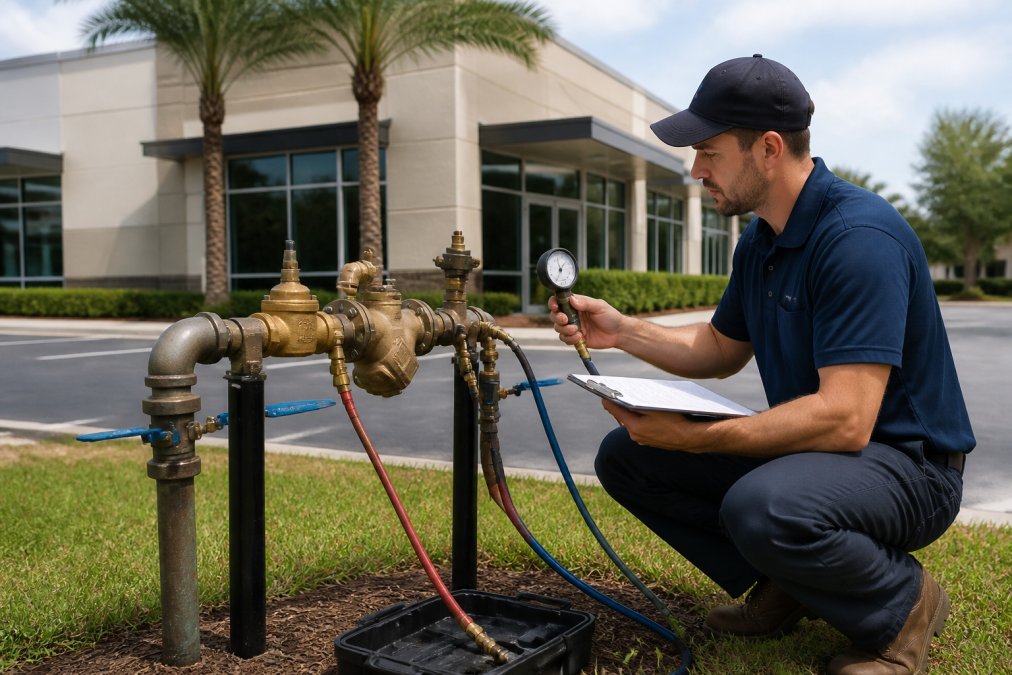
Here’s how the visit runs:
- Locate the assembly and confirm the device matches your water authority records.
- Shut off the system and relieve pressure at the test ports.
- Connect the test gauge to the upstream and downstream ports.
- Test the check valves by measuring the pressure differential at each one.
- Test the relief valve on RPZ assemblies to confirm it opens at the right point.
- Record every reading on the certification form.
- Restore service and confirm no leaks at the test ports.
- File the certification report with your local water authority.
The certification report is the deliverable, not the test itself. A passing device with no filed report is a compliance failure waiting to surface.
Common Backflow Testing Mistakes and How to Avoid Them
The most expensive backflow testing mistake is waiting until you get a violation notice. By then, you’re paying for a rush test, possible fines, and a stressed call to a plumber who may have no opening.
Other mistakes we see:
- Ignoring the monthly visual check and only testing once a year
- Using an uncertified tester whose report the water authority rejects
- Missing devices because nobody mapped the full property
- Letting a failed device sit without repair or a retest
- Skipping the certification report and assuming the test alone counts
Frequently Asked Questions
How often must you test a commercial backflow device?
Most commercial backflow prevention assemblies require annual testing, though some municipalities mandate testing every six months for high-hazard connections like fire sprinkler systems or chemical-processing equipment. Your local water authority sets the exact backflow preventer inspection frequency and sends reminder notices before the deadline. Missing a test can trigger fines or a water service shutoff, so confirm your specific schedule with the authority that governs your property.
Can I perform my own backflow test?
No. Certified backflow tester requirements typically include state or municipal certification, a calibrated test kit, and proof of insurance. Most water authorities only accept certification reports from technicians who hold a current license recognized by that jurisdiction. A DIY test will not satisfy regulatory compliance and could leave your facility exposed to penalties. Always hire a certified backflow tester who files the certification report directly with your local water authority.
What happens if a backflow test fails?
A failed test means the assembly is not preventing contaminated water from entering the potable water supply. The certified technician will document the failure, notify the local water authority, and recommend repairs or replacement of the device. You may have a limited window, often 10 to 30 days, to fix the issue and schedule a retest. In the meantime, the authority could restrict or shut off water service until the assembly passes.
Do all commercial buildings need a backflow preventer?
Not every building, but most commercial properties do. Any facility with cross-connections to the potable water supply, such as irrigation systems, fire sprinkler lines, boilers, or food-service equipment, needs a backflow prevention assembly. Plumbing code requirements vary by jurisdiction, so check with your local water authority. Even if your building was exempt years ago, changes to your plumbing system or local regulations could now require one.