


Emergency Plumbing Repair Service Cost: What to Expect


Table of Contents
- What Drives Emergency Plumbing Repair Service Cost
- Emergency Plumber After-Hours Fee: What You Are Actually Paying For
- Typical Cost Ranges for Common Plumbing Emergencies
- Your Plumbing Emergency Checklist: Before the Plumber Arrives
- How to Find a Reliable Emergency Plumber
- Red Flags of Predatory Pricing and How to Avoid Them
- Insurance, Financing, and Payment Options
- Frequently Asked Questions
Last Updated: September 24, 2026
What Drives Emergency Plumbing Repair Service Cost
Emergency plumbing repair service cost is the total amount you pay when a licensed plumber responds to an urgent problem outside normal working hours or under conditions that require immediate action. The final bill combines a service call fee, an after-hours rate, labor time, and parts.
Two variables explain most of the difference between a modest bill and a painful one.
After-Hours, Weekend, and Holiday Surcharges
The single biggest multiplier on any emergency plumbing repair service cost is timing. A standard weekday visit carries a base service call fee. The same visit at 2 a.m. on a Sunday, or on a major holiday, typically adds an emergency plumbing surcharge on top of that base.
Most companies publish this as a separate line item, which is the honest way to do it. A flat-rate pricing model quotes the whole job up front; time and materials billing charges by the hour plus parts.
A plumber who won’t quote the after-hours rate over the phone before dispatching is a problem. You should know the emergency dispatch fee and the hourly labor rate before the truck rolls, not after.
Repair Severity and Parts Availability
Severity determines labor hours; parts availability determines whether the job finishes tonight. A simple plumbing fixture repair might take under an hour. A mainline repair or pipe replacement under a slab can run most of a day.
Emergency Plumber After-Hours Fee: What You Are Actually Paying For
An emergency plumber after-hours fee covers three things: the technician’s on-call time, the dispatch cost of getting a truck to you at an inconvenient hour, and the premium the company pays to keep licensed plumbers available around the clock.
Standard Hours vs. After-Hours: What Actually Changes
Most plumbing companies run standard business hours roughly 7 a.m. to 5 p.m., Monday through Friday. Anything outside that window, evenings, weekends, holidays, triggers the after-hours rate. Here’s how the two compare on a typical service call:
| Line Item | Standard Business Hours | After-Hours / Weekend / Holiday |
|---|---|---|
| Service call / dispatch fee | $50-$150 | $100-$300 |
| Hourly labor rate | $75-$150 per hour | $150-$300 per hour |
| Minimum billing | Often 1 hour | Often 1-2 hours |
| Holiday premium | None | Frequently 1.5x-2x the standard rate |
How the Fee Is Structured
Companies use one of two models, and you should know which one you’re getting before you agree to a dispatch:
- Flat-rate pricing. The company quotes the whole job up front, including the after-hours premium. You know the number before the truck rolls. This is the easier model to budget against.
- Time and materials. The company charges an hourly rate plus parts, with the after-hours multiplier applied to the labor. The final bill depends on how long the job takes.
When the After-Hours Fee Is Worth It
Not every late-night plumbing problem needs a late-night plumber. Use this as a rough filter:
Call now, pay the premium:
- Active water spraying or pooling from a burst pipe or failed supply line
- Sewage backing up into the home
- No water at all, or a water heater leaking from the tank itself
- Any leak near electrical outlets, panels, or appliances
Wait until morning, save the premium:
- A single slow drain that still drains
- A dripping faucet or running toilet
- A water heater that’s producing lukewarm, not cold, water
- A fixture that’s loose but not leaking
Ask two questions before you agree to an after-hours dispatch: “What’s the total after-hours rate?” and “Is the dispatch fee credited toward the repair?” The answers tell you more about the company than any review.
Typical Cost Ranges for Common Plumbing Emergencies
Every emergency is different, and so is every quote. But refusing to publish numbers doesn’t help anyone at 2 a.m. with water on the floor.
| Emergency | Typical Total Cost | Main Cost Drivers | Typical Time on Site |
|---|---|---|---|
| Burst pipe | $150-$1,200+ | Access difficulty, water damage mitigation, pipe material | 1-4 hours |
| Mainline repair | $500-$4,000+ | Depth, blockage type, excavation needed | 2-6 hours |
| Water heater failure | $600-$2,500+ | Unit type, venting, code upgrades | 2-5 hours |
| Sewer line clog | $150-$800 | Camera inspection, clog location, root intrusion | 1-4 hours |
| Toilet overflow or supply line leak | $100-$400 | Fixture condition, shut-off valve age | Under 1 hour |
| Sump pump failure | $300-$1,000+ | Pump capacity, discharge line, backup power | 1-3 hours |
Burst Pipe and Mainline Repair
A burst pipe is the emergency that punishes delay hardest. That’s why shutting off the supply is the first move, not the second.
Water Heater Failure and Sewer Line Clogs
Water heater failure usually means replacement rather than repair once the tank itself has failed. Labor is predictable; the unit and code work are where the range widens.
Get the camera inspection footage emailed to you. A plumber who won’t share it is asking you to approve a four-figure repair on faith.
What Moves You Up or Down the Range
Three levers matter more than the rest:
- Timing. A weekday morning call sits at the bottom of the band. A holiday or 2 a.m. call adds an after-hours surcharge on top.
- Access. A fixture in an open basement is cheap to reach. A pipe behind finished drywall or under a slab is not.
- Parts on the truck. If the technician stocks the part, you pay one visit. If not, you pay a second dispatch fee or an overnight wait.
If a quote lands well above these bands without a clear reason, no excavation, no code upgrade, no unusual access, ask what’s driving it before you approve.
Your Plumbing Emergency Checklist: Before the Plumber Arrives
What you do in the first ten minutes decides how expensive this gets. Every minute water runs into drywall, flooring, or cabinetry adds to the final bill, and most of that damage is not plumbing work.
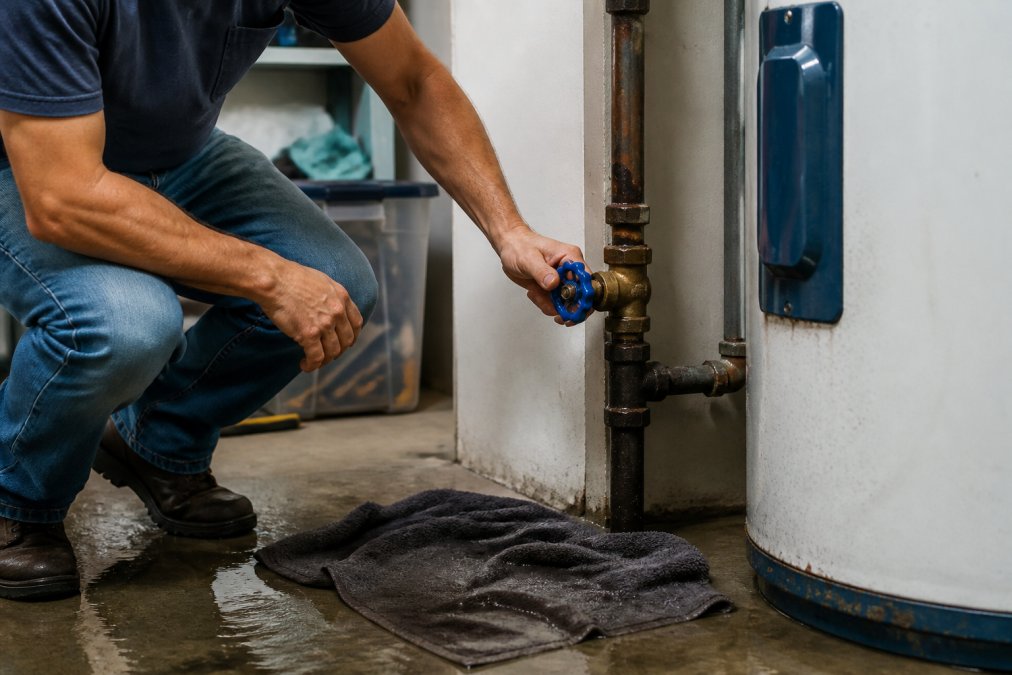
Work through this in order:
- Shut off the main shut-off valve, or the fixture valve if the leak is isolated
- Kill power to any area where water is near outlets or appliances
- Open a low faucet to drain remaining pressure from the lines
- Move furniture, rugs, and electronics clear of the water
- Photograph the damage and the source before anything is moved
- Call your insurer if damage looks significant
- Call a licensed plumber and confirm the dispatch fee up front
Photograph everything before the plumber arrives. Insurers process water damage claims far faster when the source and spread are documented, and the plumber’s report alone often isn’t enough.
How to Find a Reliable Emergency Plumber
A reliable emergency plumber is one who answers the phone, quotes the fee before dispatching, and shows up when they say they will. That sounds like a low bar. In practice, it eliminates a lot of the market.
Verify three things before you commit:
- Licensing. Ask for the license number and confirm it with your state’s licensing board.
- Insurance. An insured contractor carries liability coverage. Ask for proof.
- Written estimate. A plumbing estimate in writing, even a rough one, protects you both.
The fastest way to filter out bad actors is one question: “What’s the dispatch fee, and is it credited toward the repair?” Companies with nothing to hide answer immediately.
Red Flags of Predatory Pricing and How to Avoid Them
Predatory pricing in plumbing has a signature. It shows up as pressure, vagueness, or a number that appears out of nowhere after the work starts.
Watch for these:
- No price quoted before dispatch, only “we’ll see when we get there”
- Cash-only demands or pressure to decide immediately
- A quote that triples once the technician is inside
- No written estimate, no license number, no business address
- Upselling a full pipe replacement when a repair would do
Insurance, Financing, and Payment Options
Homeowners facing a large unplanned repair who need to spread the cost over time rather than drain an emergency fund in one hit.
Ask about payment plans before the work begins, not after the invoice arrives.
Frequently Asked Questions
How much do plumbers charge for emergency service calls?
Emergency service call fees typically include a dispatch or diagnostic charge plus an hourly labor rate that runs higher than standard business hours. After-hours, weekend, and holiday calls carry surcharges on top of the base rate. The total emergency plumbing repair service cost also depends on the repair severity, parts needed, and whether the job requires a licensed plumber for code-related work. Request a written estimate before work begins so you know the full breakdown.
What factors influence the total cost of an emergency plumbing repair?
The biggest cost drivers are the time of day, the type of repair, and the parts required. A burst pipe or sewer line clog costs more than a fixture repair because of labor time and equipment. Geographic labor rates, whether the contractor is licensed and insured, and whether a permit is required also affect the price. Flat-rate pricing gives you a set number upfront, while time-and-materials billing can vary based on how long the job takes.
How can I avoid predatory pricing when hiring an emergency plumber?
Ask for a written estimate before any work starts, and be wary of a contractor who refuses to provide one. Legitimate plumbers explain the diagnosis, show you the problem, and break down parts versus labor. Red flags include pressure to approve work immediately, cash-only demands, no physical business address, and quotes that change significantly after the job begins. Verify the license number and insurance coverage before you authorize repairs.
What should I do while waiting for an emergency plumber to arrive?
Shut off the main water valve to stop the flow, then open the lowest faucet in the house to drain remaining water from the lines. For a water heater failure, turn off the power or gas supply to the unit. Move furniture and valuables away from the affected area and use towels or buckets to contain water. If sewage is involved, avoid contact and keep children and pets clear. Document the damage with photos for your insurance claim.